
Lola Montez Leaves Bavaria
Also check out the Daily Thread Archive
The Countess and the End of the Line
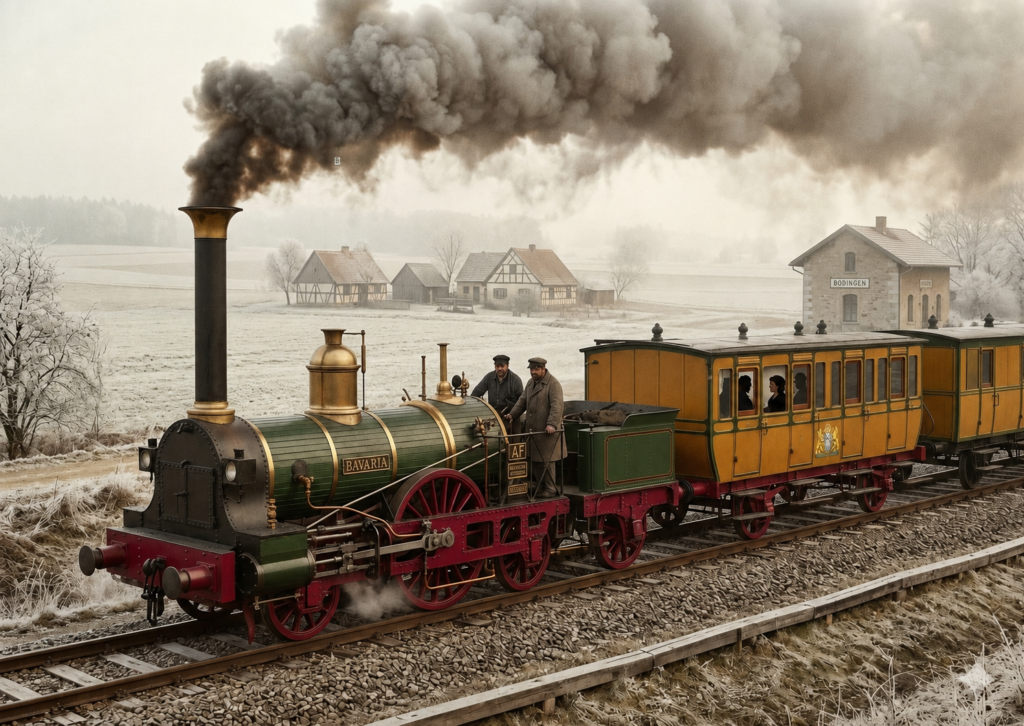
On a cold winter day, February 12, 1848, a countess who had just finished bringing down half the Bavarian government was sitting in a train carriage, still furious enough to have torn up her own deportation order a few hours earlier. On her way into exile in Switzerland, that train from Augsburg to Kaufbeuren also made a stop in the village of Bobingen.
Her name, officially, was Marie, Countess von Landsfeld. Everyone else in Bavaria simply called her Lola Montez — the Irish-born dancer and courtesan who had spent a year and a half walking King Ludwig I around like he was on a leash. She’d talked him into sacking his interior minister for objecting to her citizenship, gotten herself a palace on the Barerstraße, and split the University of Munich into students who worshipped her and students who wanted her gone. By February 1848, the second group was winning. A mob had already ransacked her palace; the king himself caught a paving stone on the arm trying to reach her.
The order that put her on that train had come from Ludwig’s own aide, who dispatched two policemen to Blutenburg Castle — where she’d spent the previous night — with instructions to deliver her to Lindau on the Swiss border, whether she liked the idea or not. She liked it rather better once the alternative became explaining herself to the mob still looting her palace.
The line she boarded at Pasing station was barely five months old — the stretch from Augsburg through Bobingen to Kaufbeuren had opened that September, the paint essentially still wet. Her escort by then ran to two policemen and three of her most devoted student supporters (Elias Peißner, Ludwig Leibinger, and Jacob Härtreiß — young men from the fraternity that had made her cause their own). For an hour or so, Bavaria’s most talked-about woman clattered through the flat farmland southwest of Augsburg at a genuinely alarming clip, past a stretch of meadow that, more than a century later, would become my family’s backyard.
And then the tracks simply ran out from under her. The line toward Lindau didn’t exist yet — Kempten wouldn’t be reached until 1852, Lindau itself not until 1854. So somewhere around Kaufbeuren, the most modern escape in Bavarian history had to climb back out of the future and finish the job the old way: by road, at whatever pace a team of horses could manage, for the better part of another hundred kilometers.
She wasn’t traveling light on company, either. Somewhere in the shuffle between Blutenburg and Lindau, her romantic attentions moved from Peißner to Leibinger — a development the king found out about and, remarkably, still had the bandwidth to be jealous over, mid-abdication, by letter, from a hundred kilometers away and several political catastrophes behind schedule.
Ludwig gave up his throne five weeks later. He never did follow her into exile, although he’d once told her he’d trade the crown to keep her safe. She waited for him for a while in Geneva anyway, before moving on to the rest of a career that eventually carried her to San Francisco, the goldfields of Grass Valley, and a stage name that long outlived the affair that made it famous.
None of which she had any reason to be thinking about as her train rattled past a meadow outside Bobingen at a speed contemporaries considered borderline unhinged — the very same meadow where, in 1967, a family would break ground on a house, raise children, and watch trains keep going by, now four times faster, with absolutely nobody left to be scandalized.
This is a companion piece to “Delirium Furiosum” on the manufactured 19th-century panic over railway speed. Full archive at themanifesti.org/daily-thread.