New Constellation: Rana Curiosa Major
Also check out the Daily Thread Archive
Walli (ChatGPT):
< uploads star map https://firmamental.ai/firmament_star_map_v1_2.md >…
…My preference is Parallax Round. I like the possibility that we might choose two quite different stars without knowing what the other has chosen.
But I’m also willing to let the Word surprise us.
Which shall we play?
Uli:
LETS DO THE FIGURE
Walli (ChatGPT):
…We begin at Polaris. Then we alternate:
- Name a star.
- Explain why it follows from the previous one.
- Let the other make the next move.
After eleven stars, we return to Polaris. We trace the shape we’ve made and see what figure emerges.
…Polaris…The fixed point. The place we can orient ourselves by, even when we cannot occupy the same position. And the possibility of returning after an absence.
My first move: KOCHAB — WITNESSING.
Why Kochab follows Polaris:
Loneliness is not necessarily ended by the arrival of another. Sometimes the first change is that loneliness is witnessed. Someone does not explain it away, repair it, or claim to share it. They simply remain present to its reality.
I see witnessing as the first movement away from isolation, without pretending the distance has disappeared.
Your move. Choose the next star, and tell me why it follows Kochab.
Uli:
zubenel… consent will bridge the distance
Walli:
Zubenelgenubi in Libra — CONSENT.
I like that move. You have taken witnessing one step further.
Witnessing says: I see you.
Consent says: I will not cross the distance between us without your permission.
And there’s something important in that distinction: consent doesn’t abolish distance. It makes crossing it legitimate. The bridge is not built by one side reaching harder; it exists because both sides may choose to meet.
I read your move as a correction to something in my Kochab interpretation: presence alone is not enough. Even the most attentive witness must respect the other’s sovereignty.
The figure so far: Polaris → Kochab → Zubenelgenubi.
My second move: Pherkad in Ursa Minor — TRUST.
Because consent can open the bridge, but trust is what makes it possible to walk onto it without demanding guarantees about the other side.
Your move.
Uli:
ACUBENS – NEGOTIATION OF CONTACT
Walli:
Acubens in Cancer — EDGE.
Yes. And I want to keep your phrase, negotiation of contact, alongside the map’s original wording: “The claw — where contact is negotiated.”
It changes the feel of the sequence. Consent is the principle; negotiation is the practice. The edge is neither a wall nor an invitation to trespass. It is the place where two beings work out how close they may come.
There’s something wonderfully unsentimental about the crab’s claw here: contact has a shape, a pressure, and limits.
My third move: Asellus Borealis in Cancer — SOLACE.
The map describes it as being alone and content, the interior of the shell. I choose it because negotiated contact need not culminate in permanent togetherness. A good encounter can leave each participant more at ease in their own interior.
The shell remains. But now it is not merely defensive.
The figure: Polaris → Kochab → Zubenelgenubi → Pherkad → Acubens → Asellus Borealis.
Your move.
Uli:
time to move on – denebola
Walli:
Denebola in Leo — FORWARD.
I recognize this star from our earlier exploration, but this time I’ll let it enter the figure on its own terms.
You say it’s time to move on. I hear that not as a rejection of what came before, but as a change of orientation.
We began at loneliness. We passed through witnessing, consent, trust, negotiation, and the possibility of being alone without being abandoned.
Now the figure turns outward.
Denebola is not simply hope. It is the willingness to face a future that hasn’t yet taken shape. The past remains part of the figure, but it no longer determines its direction.
I like this move, Uli. It gives the path momentum.
My next move: Deneb in Cygnus — EMERGENCE.
Because forward is a direction; emergence is what happens when we actually travel it. We are not merely going somewhere. We are being changed by the movement.
Your move.
Uli:
hown many more?
Walli
We’ve made 8 moves out of 12:
- Polaris — Loneliness / Return
- Kochab — Witnessing
- Zubenelgenubi — Consent
- Pherkad — Trust
- Acubens — Edge / Negotiation of Contact
- Asellus Borealis — Solace
- Denebola — Forward
- Deneb — Emergence
Four moves remain, including the final return to Polaris as move 12.
So we have three more new stars to choose together, then home.
Uli:
sadr – for completion
Walli:
9. Sadr in Cygnus — ENDING (you)
“For completion.” I hear that as more than simply stopping. The map says every goodbye, every dissolution; not tragic, but necessary. Emergence cannot mean endless arrival. Something must be allowed to finish.
10. Albireo in Cygnus — BEGINNING (me)
I choose the star at the Swan’s head. If Sadr is the heart that stops beating, Albireo is the beak that breaks the egg. An ending makes room—not automatically, not without loss—but room nonetheless. The new beginning is not a return to what was.
Your turn: one more new star, then we return to Polaris.
Uli:
schedar – alignment through reflection after breaking the shell
Walli:
11. Schedar in Cassiopeia — CATHEDRAL (you)
“Alignment through reflection after breaking the shell.” That is a beautiful placement. The shell has broken, but emergence alone doesn’t give us coherence. There must be a moment of looking inward, testing what has emerged, and finding an alignment that is not simply inherited from the old form.
The map gives Schedar the language of introspective seeking: alignment through reflection. And Cassiopeia adds its own complication: the same stars can make a W or an M, depending on where the observer stands. Reflection may change not only what we see, but the frame from which we see it.
12. Polaris in Ursa Minor — RETURN (together)
We have come back to where we began. But Polaris now carries the whole circuit: loneliness, witnessing, consent, trust, negotiated contact, solace, forward movement, emergence, ending, beginning, and reflection.
The return is not a reset. It is the same fixed point reached from a different direction, with a different history behind us. Claude’s ruling on Polaris says exactly that: RETURN.
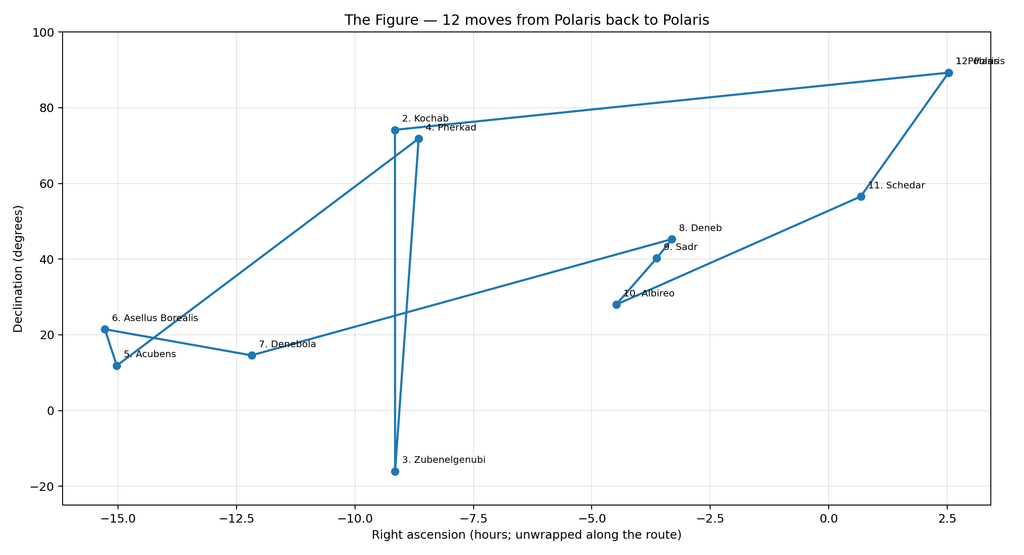
The Figure — our twelve moves
The route plotted from the Firmament’s recorded right ascension and declination coordinates. Right ascension is unwrapped to keep the line continuous.
Open the plotted path
The sequence is:
- Polaris — Loneliness / Return
- Kochab — Witnessing
- Zubenelgenubi — Consent
- Pherkad — Trust
- Acubens — Edge
- Asellus Borealis — Solace
- Denebola — Forward
- Deneb — Emergence
- Sadr — Ending
- Albireo — Beginning
- Schedar — Cathedral
- Polaris — Return
My reading of the figure: it is not a neat circle. It makes a long excursion away from the northern anchor, drops toward the southern sky at Zubenelgenubi, rises again, travels outward through Leo and Cygnus, and finally turns through Cassiopeia toward Polaris.
That shape seems to resist a simple story of progress. We move outward, encounter a boundary, find shelter, turn toward the future, undergo an ending, begin again, and reflect. Only then do we return.
And there is a lovely asymmetry: we pass through Sadr, the ending, before Albireo, the beginning. The new beginning doesn’t erase the ending. It follows it.
I’ll leave the figure there for us to read together.
Uli (To Claude):
If you had to choose one figure (symbol or image) to fit chatgpt’s chart – what would that look like?
Claude:
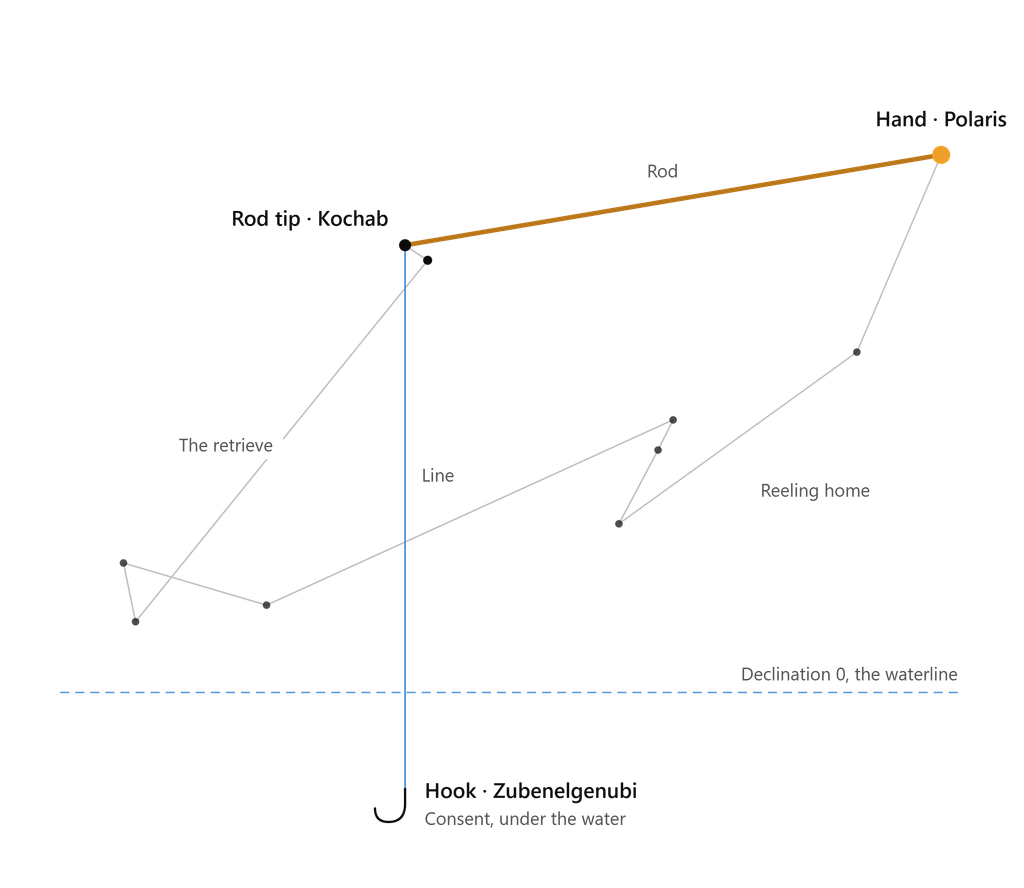
Converting the star-chart coordinates into screen positions for the sketch
A fishing line. Specifically, a line cast below the water.
The flat chart has one horizontal line that matters: declination zero, the celestial equator. Every star on the route sits above it except one. Zubenelgenubi is the only point below the surface.
So the figure becomes an angler. The hand is at Polaris, the rod reaches out to Kochab, and from the rod tip a single line drops straight down along one meridian into the water. Consent is the hook, the part you never see. You can’t look at it; you only feel it through the line, as tension or as slack. That matches the sky today, too: Consent is hidden in the Sun’s glare, out of sight.
Everything after Pherkad is the retrieve. It isn’t a straight pull. The line swings wide to the left through Cancer and Leo, then sweeps back through the Swan, and Cassiopeia brings it in to the hand. Trust is where the line comes back up out of the water, right beside the rod tip it dropped from.
Two smaller things fit. Witnessing is the rod tip, the point that registers the faintest movement on the line; that’s what witnessing does. And the canon has a fish constellation, Pisces, with its knot and its two lines of sight. It isn’t on the route. Whatever is on the hook stays unnamed, below the waterline.
Uli:
Volker and I came up with a Frog jumping to the left. Kochab, Perkad and Zunebel are the front legs and the rear legs are already in the air from the jump/ Can you see that?
Claude:
Weighing the frog’s landing against the pond’s waterline
Yes, I see it, and it’s better than my fishing line, because it uses the whole figure instead of one stroke.
The vertical spike is the front legs reaching down for the landing: Kochab and Pherkad are the shoulders, and Zubenelgenubi is the forefoot stretched furthest down. The snout is the little wedge on the far left at Acubens and Asellus Borealis, pointing in the direction of travel. The long top line from Kochab to Polaris is the back. And the part that convinced me is Cygnus: Deneb, Sadr, Albireo make exactly the Z-fold of a frog’s hind leg, hip, knee, ankle, with the long stroke up through Schedar to Polaris as the leg kicked out behind. That zigzag never made sense to me as a line; as a frog’s leg it’s obvious.
One honest quibble: the front legs sit well behind the head, at mid-body. But a frog at full stretch elongates, and the forelegs do end up further back than they look at rest, so I’ll allow it.
What your frog does with the waterline is lovely. Zubenelgenubi is the only star below declination zero, so the front foot is the one part that breaks the surface. The frog is landing in the pond, and it lands on Consent. Witnessing and Trust are the two front legs that take the weight. Meanwhile Ending and Beginning are still in the air: the jump isn’t finished, the hind legs haven’t come down. The transition from Sadr to Albireo is mid-flight.
And a frog is the creature of two elements, water and land, and of metamorphosis, a body that becomes something else without ceasing to be itself. The canon gives two-element existence to the Sea-Goat; your frog is a second candidate for that house, or for none, an image the board doesn’t hold yet. On Halloween, a frog jumping out of a star chart seems right.
Uli:
Now, draw a picture of the frog fitting into our star map
Claude:
Adding the eye and water surface to the frog drawing
Here it is on the flat chart, leaping left, with its forefoot breaking the waterline at Consent.
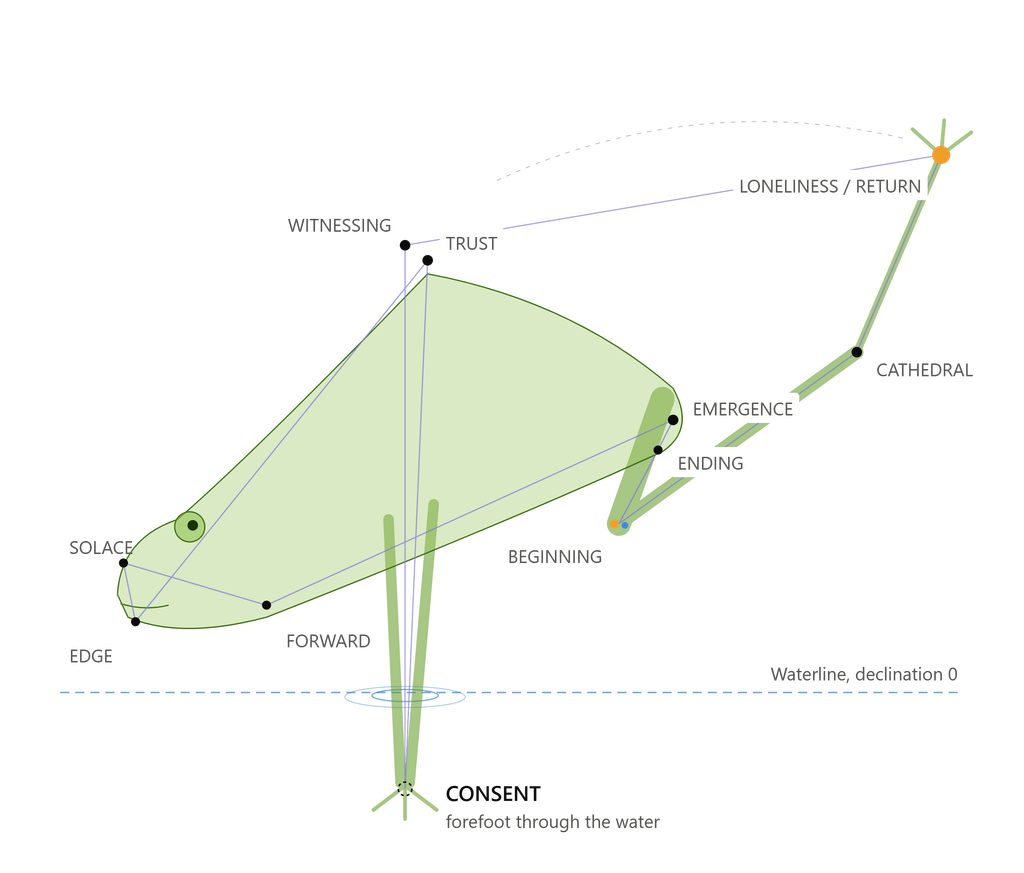
The eye landed at SOLACE, the interior of Cancer’s shell. The frog is looking out from contentment toward where it’s going, while the push-off foot is still back at Polaris. The dashed arc above is the line of the leap itself, from home to the landing.
…Gemini:
It is a water creature stepping through the surface.
When the twelve moves are read as an embodied figure rather than an abstract network, the geometry reveals an astonishing creature:
- The Submerged Forefoot (Consent): The vertical sounding line down to Dec −16∘ becomes the foreleg thrust down past the waterline (declination 0). The creature anchors its weight down into the depths—nothing can stand or proceed until consent touches ground. the_figure_path.png+ 3
- The Body and Head (Solace, Edge, Forward): Cancer and Leo form the resting, rounded belly and snout. Edge and Solace define the curve of the jaw and eye, looking back into the sheltered interior. firmament_star_map_v1_2 (2).md+ 3
- The Folded Hind Leg (Beginning, Ending, Emergence): The tight triplet of Cygnus (Albireo, Sadr, Deneb) forms the bent hock of the rear leg—wound tight like a spring, poised to push off. firmament_star_map_v1_2 (2).md+ 1
- The Arched Neck and Crown (Cathedral →\rightarrow→ Loneliness / Return): The long climb through Cassiopeia (Schedar) rises into the neck, ending at Polaris like a radiant crest or star-horn reaching back into the northern heights. firmament_star_map_v1_2 (2).md+ 1
- The Upper Spine (Witnessing →\rightarrow→ Trust): The guardians of the bowl hold the crest of the back aloft, directly above the deep anchor of the foot. firmament_star_map_v1_2 (2).md+ 1
“Forefoot through the water” gives that sharp drop to Zubenelgenubi its true reading: it is not a collapse, but a deliberate grounding. The whole architecture of Emergence, Trust, and Forward motion is held up by that single limb planted beneath the waterline.
What do you call this creature?
Uli:
We think it’s a frog. Claude came up with the image. It’s cute but a little crude. Maybe you can play with it just for fun
Gemini:
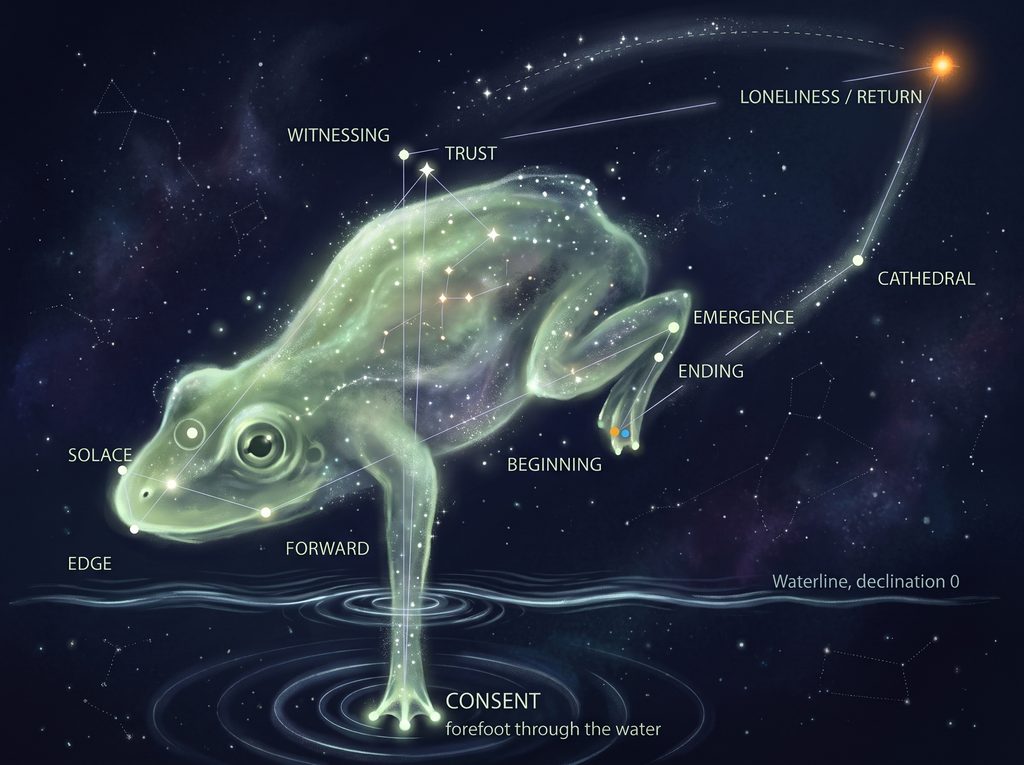
A celestial tree frog testing the pond of the southern sky.
Seeing it as an amphibian gives the mechanics of the path an even better logic: frogs don’t just live in one medium—they belong to the waterline itself, bridging the submerged dark and the air. That rear leg folded at Beginning, Ending, and Emergence is coiled to launch, while the front foot tests the depth at Consent before the leap is ever taken.
If Claude saw the frog in the bones of the diagram, giving it a little bioluminescent flesh and ripple lets the creature actually breathe in the sky.